Skincare Beauty Product Organization: Developer's Minimalist
A developer's sink counter is usually piled high with skincare products, some of which you don't even know when you bought. This post shares a minimalist...
The first time my girlfriend came over and saw my sink counter, she had a complicated look on her face.
"Why does one person have eight bottles of face wash?"
I counted. She was right. Three face washes on the counter, two toners, one lotion, one serum, and a jar of moisturizer. There were more in the drawer—face masks hoarded from a sale, travel-size samples from a hotel stay, and a "men's" skincare product I got suckered into buying on someone's recommendation.
She picked up one of the face washes and looked at it. "This one's expired." She picked up another. "This one's expired too."
After checking them all, three of the eight face washes were expired, two had been used a few times and then abandoned, and only three were actually in use. The other products were pretty much the same story.
As a developer, I prefer simplicity and efficiency in my code, but when it came to skincare, I'd fallen into the "over-engineering" trap—bought a bunch of tools without any clear execution process.
Step 1: Take Stock—Figure Out How Much You Actually Have
I pulled out every single skincare-related item in the house and laid them on the bathroom counter:
- Face wash: 8 bottles
- Toner/cleansing water: 5 bottles
- Lotion/moisturizer: 6 bottles
- Serum: 3 bottles
- Face masks: 2 boxes + a bunch of loose ones
- Sunscreen: 4 bottles
- Shaving supplies: 2 razors, 3 cans of shaving foam, 2 bottles of aftershave
- Other: eye cream, lip balm, acne cream, pore strips, etc.
Over 40 items in total. And my actual daily skincare routine was only three steps: wash face, apply lotion, occasionally shave.
That meant most of these products were "redundant dependencies"—imported, but never used, just adding to the maintenance burden.
Step 2: Declutter—Establish a "Retirement Mechanism" for Skincare
I did the first round of filtering based on these rules:
- Expired stuff goes straight in the trash
Expired skincare is no joke—especially sunscreen and products with active ingredients. Once expired, they can become ineffective, or even irritate the skin. I checked the production date and shelf life on every bottle, and the expired ones went right in the bin.
- Opened for more than a year? Handle with caution
The shelf life on the package is for the unopened product. Once opened, the actual usable life is much shorter. Most skincare should be used up within 6-12 months of opening. I tried to remember when I opened each bottle. If I couldn't remember, I assumed it was "past its service life."
- If it doesn't feel good, stop forcing it
Some products sting, turn my skin red, or break me out—they're just not right for my skin. I used to think "maybe my skin hasn't adjusted yet" and let them sit around waiting to "try again." Now I get it: if it doesn't suit you, it doesn't suit you. Like an incompatible dependency, forcing it in only causes more problems.
- For duplicate functions, keep only one
Five toners that all do basically the same thing? Keep my favorite one, deal with the rest.
After this round, my skincare went from 40+ items down to around 15.
Step 3: Understand Your Real Needs—The Developer's KISS Principle for Skincare
The KISS principle (Keep It Simple, Stupid) works in skincare too. As a developer who stares at a screen for over 10 hours a day, my core skincare needs are actually pretty simple:
- Cleansing: Wash off the oil and dust on my face
- Moisturizing: Prevent skin from drying out due to air conditioning and late nights
- Sun protection: Block UV damage (even if you sit by a window, this matters)
- Shaving: Keep my face looking clean
With these four needs in mind, I redesigned my skincare routine:
Morning routine (3 minutes):
- Wash face with warm water (use a small amount of face wash if I applied heavier products the night before)
- Moisturizing lotion
- Sunscreen (if I'm going out or sitting by a window)
Evening routine (5 minutes):
- Cleanse with face wash
- Moisturizing lotion or cream
- Shave if needed
Weekly (10 minutes):
- Deep-cleansing mask or exfoliation (pick one, don't do both)
This routine is so simple it doesn't require thinking—the execution cost is basically zero. Like well-designed code, the logic is clear with no redundancy.
Step 4: Build a "Minimum Viable Skincare Set"
Based on the routine above, I put together a minimum viable skincare set:
Core three:
- Face wash: A gentle amino acid face wash, can be used morning and night
- Moisturizer: A lotion or cream, with texture chosen by season (lotion in summer, cream in winter)
- Sunscreen: An everyday sunscreen, SPF30-50, PA+++
Shaving set:
- A razor that feels right (electric or manual, pick the one you're used to)
- A bottle of shaving foam or gel
- Aftershave or moisturizer (can share with the moisturizer above)
Optional extras:
- A lip balm (for winter or air-conditioned rooms)
- A jar of cleansing mask (for weekly deep cleansing)
In total, no more than 10 products—everything fits in a small organizer.
Step 5: Physical Organization of the Sink Counter
With fewer products, organizing becomes much simpler.
Counter area:
Only three daily essentials go on the counter: face wash, moisturizer, and razor. Everything else gets put away. The fewer things on the counter, the easier it is to clean and the better it looks.
Drawer area:
Use a divided organizer box to sort the products:
- Front row: daily core products
- Middle row: weekly products like face masks
- Back row: backup and seasonal products (winter cream, summer sunscreen)
Mirror cabinet area:
If you have a mirror cabinet, put less-used items on the top shelf and everyday items on the bottom—same logic as cache strategy in code: hot data goes in the fastest access position.
Step 6: Build Buying Discipline—Prevent Bloat
Skincare is one of the easiest categories for impulse buying. A recommendation on social media, a flash sale in a live stream, a friend saying "this is amazing"—any of these can send you checking out with something you don't need.
I set a few rules for myself:
- Buy when you run out—don't stockpile
Skincare isn't toilet paper; you don't need to stock up. One bottle of face wash lasts 2-3 months. Buy a new one when you're about to run out. Stockpiling usually means things expire before you use them, or you get bored mid-bottle and want to switch.
- Only one product per category open at a time
Don't open multiple face washes or lotions at the same time. Open one, finish it, then open the next. This way you know exactly how long each bottle has been open, and you avoid waste.
- Try samples before committing to a full size
If something new catches your eye, buy a sample or travel size first. Once you confirm it works for you and you actually want to keep using it, buy the full size. Like A/B testing in code—validate on a small scale before full rollout.
- Set a skincare budget
Set a monthly cap on skincare spending. Anything over the cap, wait until next month. This limit is great for filtering out impulse buys.
Step 7: Travel Set Management
Developers travel a lot for work, and managing travel-size skincare is its own challenge. I used to squirt a little from various bottles into travel containers before each trip—annoying and prone to leaking.
My current solution:
- Keep a fixed travel set in the suitcase, ready to go
- The travel set contains small bottles of the three core products
- After each trip, check the levels in the travel bottles and refill as needed
- The travel bottles are uniform and labeled to avoid mix-ups
With this setup, no extra prep is needed before a trip—just grab the suitcase and go.
Wrapping Up
For a lot of developers, skincare might feel "too much trouble" or "unnecessary." But in reality, spending 5 minutes a day on basic care has a big long-term impact on skin health. Developers in particular—who spend long hours in front of screens and often pull late nights—tend to have worse skin than their peers, so basic care matters even more.
The key is not making it too complicated. You don't need to become a skincare expert, and you don't need to buy a pile of products. Find a simple routine that works for you, and stick with it—the results will be way better than buying a bunch of high-end products you use inconsistently.
It's just like writing code: the best solution is rarely the most complex one—it's the simplest one that you can keep running. A three-step skincare routine you can keep up for a year will beat a ten-step routine you abandon after two weeks.
If you want to simplify your skincare routine, try starting this weekend: dump out all your skincare products, toss the expired and unused ones, and keep just the core three. Stick with it for a month and see if your skin changes. Once it's stable, decide whether you want to add any extra steps.
Related Articles
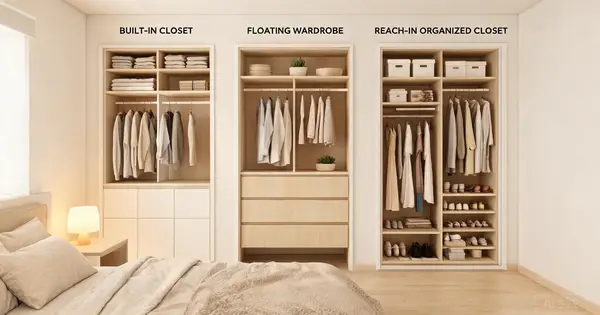
9 Closet Designs Compared: Best for Small Spaces 2026
From floor-to-ceiling built-ins to floating wardrobes — compare 9 small closet designs for 2026. Find the perfect space-saving solution for your apartment.

Low-Maintenance Storage: 5 Designs for a Cleaner Small Apartment
Storage should save space AND save your time. Explore 5 low-maintenance storage designs that keep your small apartment cleaner with less daily effort.

Multi-Purpose Balcony: Laundry, Cleaning, Pets & Plants in One
Your balcony can be more than a drying rack. Design one zone that holds a washer-dryer, cleaning tools, pet supplies, and plants without them fighting.

The 80/20 Storage Rule: How to Apply the 'Hide 80%, Show 20%' Philosophy in Your Small Apartment
The 80/20 storage rule is 2026's hottest home organization philosophy. Learn how to hide 80% of your belongings and display 20% to make your small apartment feel spacious, tidy, and effortlessly stylish.

Small Dining Room Storage: 10 Solutions for Your Apartment
Your small dining table is buried under mail, groceries, and clutter. Discover 10 smart storage solutions for small dining rooms — from wall shelves to multi-functional furniture.

Entryway Pegboard Storage: No-Drill Vertical Solution for Rentals
Transform your entryway with pegboard storage that requires zero drilling. Perfect for rentals, this vertical solution maximizes space for coats, bags, and daily essentials.