Developer's Guide Souvenirs Sentimental Clutter: Storage
Developers think logically, but sentimental items—gifts, photos, travel mementos—often stump them. This post shares a souvenir categorization method, digital...
In my rental, there's a cardboard box that's been there since the day I moved in. Three years, never opened.
Last week while tidying up, I finally opened it. What was inside? A birthday gift from a college roommate (a power bank that's now dead), a name badge from my first tech conference (2018), a hand-knitted scarf from an ex (we broke up two years ago), a lucky cat I bought in Japan (the tail broke off), and at least 50 photos—graduation pics, team-building pics, hackathon shots, and a few I couldn't even recognize where they were taken.
I sat on the floor, staring at this box for half an hour. Throw it away? I can't bring myself to. Keep it? It takes up space, and I haven't touched most of it in three years. I bet a lot of people share this kind of indecision.
As a developer, I'm used to solving problems with logic. But with sentimental items, logic doesn't really work. So I changed my approach: I used a "system design" mindset to build a management framework for emotional items.
Why Souvenirs Pile Up: The Psychology
First analyze the requirements, then design the solution. That's a developer's basic skill.
Why are souvenirs so hard to throw away? I summarized three psychological reasons.
Sunk cost. I spent real money on this thing, or someone spent their time and energy to give it to me. Throwing it away is like admitting that "investment" failed. But the truth is, an item's value isn't in what you paid for it—it's in what it gives you right now.
Emotional attachment. Every souvenir is tied to a memory. Throwing it away feels like throwing away the memory itself. But memories live in your brain, not in that lucky cat. The item is just a trigger, not the memory itself.
Identity. We keep certain items because they represent "who I am." For example, a conference name badge represents "I'm a member of this community." But identity doesn't need to be maintained by physical items—your GitHub contribution graph is way more convincing than a name badge.
After understanding these three reasons, my attachment to these items lightened up a lot. It's not that I stopped cherishing the memories—it's just that I stopped tying the memories to the items.
The Souvenir Categorization Method: Core, General, and Let-Go
I built a three-tier classification system.
Core (keep, with a clear display or storage plan):
These items meet at least one of these conditions:
- I take it out and look at it at least once a year
- It has irreplaceable emotional value (like a handwritten letter from family)
- It's compact and the storage cost is low
I only kept 5 core items: a family photo (in my wallet), a contributor medal from a tech community (hanging next to my desk), a college notebook full of notes (on my bookshelf), a coin my grandfather gave me (in a small box), and a group photo with my team (digitized, but the physical one stays).
General (keep, but stored together, not on display):
These items have some value but don't need to be in front of me every day. I keep them in a single storage box, slid under the bed. Inside: the remaining few dozen photos, a few meaningful name badges, some postcards.
The box is semi-transparent, so I know what's in there, but I don't have to face it every day. I open it once a year at the end of the year, take a quick look, and decide if anything needs to be promoted to "core" or demoted to "let-go."
Let-go (get rid of):
These items meet at least one of these conditions:
- Haven't touched in three years, and can't even remember the last time I touched them
- Already damaged or deteriorated (like a dead power bank, a cat with a broken tail)
- Tied to negative or neutral memories, no reason to keep them
The power bank—I tossed it. Hadn't used it in three years, and the technology has moved on by several generations. The cat with the broken tail—I tossed that too. Damaged items have no value to keep. The ex's scarf—I donated it. The memory is from a past relationship, no need to keep it now.
Organizing Photos and Digital Souvenirs
Photos are the bulk of souvenirs, and the easiest to digitize.
Physical photos: I scanned all my physical photos and saved them to the cloud. I used a phone app, the resolution was more than enough. The physical photos themselves, I picked 10 of the most meaningful ones to keep, and shredded the rest. The 10 physical photos went into a small photo album, and the album is in the core storage area.
Digital photos: I regularly organize my phone's photos, sorting them into folders by event. Each trip, each activity, each milestone gets its own folder. Folder naming convention: [YYYYMMDD]_[Event], e.g., 2023-10-01_Hangzhou_Team_Building.
Social media digital mementos: For content on WeChat Moments, Weibo, Instagram, I export it every six months. Use third-party tools to bulk download, save to local hard drive + cloud drive. These digital items are easier to lose than physical photos (platforms can shut down, accounts can be banned), so backups are important.
Display Storage for Physical Souvenirs
A few of the core items I chose to display, rather than stash in a box.
Contributor medal: Hangs on the wall next to my desk, visible every day. It reminds me that my technical skills are recognized by the community. This kind of positive feedback is great for a developer's mindset.
Family photo: I took it out of my wallet and switched to a digital version saved on my phone. The physical photo went into a small frame, on the bookshelf. The frame is 5x7 inches, doesn't take up much space.
Notebook: Sits on the bookshelf, right next to my remaining 8 paper tech books. It's basically a book, just one I wrote myself.
The principle of display storage: only display items you "still identify with." If an item represents an identity or value you no longer connect with, take it down from the display area. The display area is for "who you are now," not a museum of "who you were."
The "One Box Rule": All Souvenirs Fit in One Storage Box
This is a hard rule I set for myself: all non-display souvenirs must fit in a single standard storage box.
The box is 40L, roughly the volume of 50 books. Currently, my "general" category souvenirs take up about 2/3 of the space, with 1/3 to spare.
The point of this rule: it forces a hard limit on the total volume of souvenirs. If the box is full and I want to add a new souvenir, I have to remove one from the box. One in, one out—total stays constant.
This rule sounds a bit cold, but in practice it's not that hard. You don't add souvenirs that often—maybe a few a year, retire a few, the box doesn't fill up.
But if the box is actually getting full, that means your "emotional hoarding" tendency is getting serious, and it's time to be careful. Stop and look at the contents again—see if there's anything to simplify further.
The Annual Review and Declutter Habit
At the end of each year, I do a full souvenir review. The flow:
- Open the storage box and take everything out.
- For each item, ask three questions:
- Have I thought about this item in the past year?
- Can I recall the memory attached to this item without looking at it?
- If I lost this item, would I be upset?
- If the answer to all three is "no / yes / no," let it go.
- Check the core items, confirm they still deserve to be on display.
- Update the digital backup, confirm all photos and digital souvenirs are archived.
This flow is once a year, taking about 1-2 hours. Not long, but it effectively prevents the souvenir pile from growing without bound.
Wrapping Up
After finishing that cardboard box, there's a half-full storage box under my bed, an extra photo frame and a notebook on the bookshelf, and a medal on the wall. The rest was either thrown out, donated, or digitized.
I didn't forget the related memories just because I got rid of those things. In fact, the organization process made me re-remember them, and the memories got clearer. Items are just the vessel for memory, not memory itself. Once you decouple memory from the item, you feel a lot lighter.
Developer thinking trains us to pursue efficiency and simplicity, but managing emotional items can't be measured by efficiency alone. The core isn't "how much to throw away"—it's "what to keep." Keep what truly matters, let go of what no longer matters, and keep both your physical space and your mental space clean.
If you have a cardboard box that hasn't been opened in three years, find a weekend to open it. No need to rush to throw things away—look at each item one by one, think about each one. You'll find that a lot of things you thought you couldn't part with actually don't matter that much anymore.
Related Articles
Developer's Cure-All Bag: Organizing Commuter Bags, Travel
Developers carry a lot of stuff in their daily bag—laptops, chargers, earbuds, pens, tissues, all over the place. This post shares commuter bag...
A Developer's Coffee/Tea Setup: How Build Desk Drink Station
Developers run on coffee, and with all the gear and tea varieties, things can get messy fast. This post covers how to build a desk drink station—from a...
Developer's Toolbox Organization: DIY Repair Tool Storage
Developers love to tinker, and homes are full of repair tools, but the one you need is never around. This post shares a tool categorization system, toolbox...
Fridge Organization Hacks: Developer's Quick-Prep Food
A developer's fridge is often a black box—stuff goes in and gets forgotten, until one day you smell something funky and remember to clean. This post shares a...
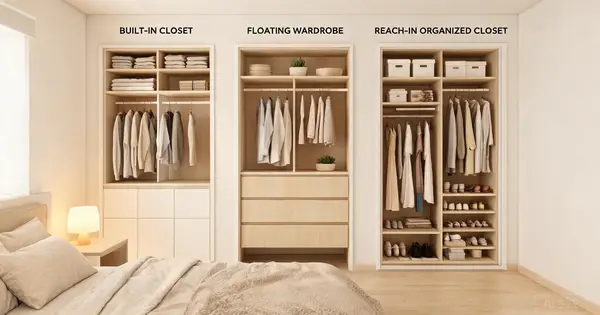
9 Closet Designs Compared: Best for Small Spaces 2026
From floor-to-ceiling built-ins to floating wardrobes — compare 9 small closet designs for 2026. Find the perfect space-saving solution for your apartment.
Low-Maintenance Storage: 5 Designs for a Cleaner Small Apartment
Storage should save space AND save your time. Explore 5 low-maintenance storage designs that keep your small apartment cleaner with less daily effort.