Display, Don't Hide: 200+ Books & Vinyl in a Studio
I display 200+ books and vinyl records in my 28sqm studio without losing floor space. Here is my 4-zone system, lighting tricks, and the shelves that survived 2 moves.
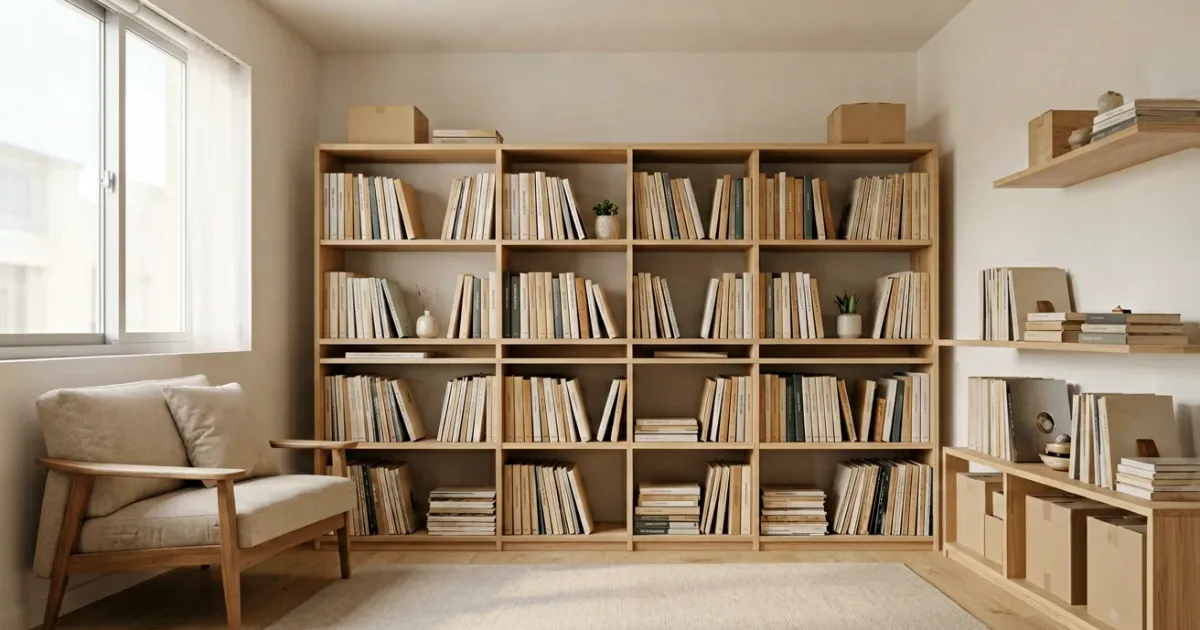
When I moved into my 28sqm studio, the moving boxes held 217 books, 89 vinyl records, 14 magazines I refuse to recycle, and one framed poster. My first instinct was to buy a closed cabinet and hide everything. After six months of stacking books behind sliding doors, I pulled them all out. The studio felt smaller, not bigger. The books were working harder as decor than they were as storage.
This is the 4-zone system I built instead. It displays all 200+ items, uses zero floor space I did not already need, and survived two moves. It also gave me back something I did not expect: a daily ritual of seeing the books I love, instead of forgetting which ones I own.
The Mindset Shift: Show, Don't Store
The organizing industry spent fifteen years telling renters to "declutter and hide." The 2026 shift is the opposite. Designers from Tokyo to Brooklyn are treating collections as primary decor, not as clutter to be concealed.
There is a real reason it works in a small apartment. A wall of closed cabinets eats visual space. A styled open shelf expands the room. Your eye reads a curated open shelf as "this person has taste" and a closed cabinet as "this person is hiding things." A studio that displays what matters to you feels larger because every wall has a job.
The 4-zone system applies this principle to four different collection types: books, vinyl, magazines, and sentimental objects. Each zone has its own rule, shelf, and lighting.
Zone 1: The Book Wall (Vertical Books + Horizontal Stacks)
The book wall is the foundation. I dedicated one full wall (180cm wide × 220cm tall) to books, arranged in three vertical sections.
The rule: 70% vertical books, 30% horizontal stacks. Pure vertical looks like a library archive. Pure horizontal looks like a thrift store pile. The 70/30 split breaks the visual rhythm and gives you a place to put a small object on each horizontal stack — a candle, a plant, a postcard from a trip.
Shelf depth matters more than shelf count. Standard shelves are 25cm deep. For a 28sqm studio, drop to 18cm deep. You lose 7cm of "shove a second row of books behind the first" space, but you gain 18cm of walking room in front of the shelf. That is the difference between brushing the shelf every time you pass and walking freely.
I used a mix of IKEA LACK floating shelves (18cm deep, 60cm wide, $8 each) for the upper rows and a single IKEA KALLAX 2×2 (33cm deep) on the bottom row for the oversized art books that would not fit on a floating shelf. The combination cost less than $120 for the entire wall.
The IKEA LACK floating shelf is the cheapest 18cm deep option. $8 each, holds 5kg, and the white finish disappears into most wall colors.
Zone 2: The Vinyl Display (Functional Art)
Vinyl has a problem in a small apartment: it is bulky, it is heavy, and most "vinyl storage" furniture is full-size credenza depth. The 89 records in my collection would fill a 90cm wide credenza.
The solution is vertical wall-mounted vinyl shelves. A 30cm wide × 30cm tall wall-mounted slot holds 30–40 records and reads as decor, not storage. I installed two slots at 150cm height, flanking the TV. The records are visible, accessible, and double as wall art.
The rule: display the front 30, store the rest in under-bed boxes. I rotate the front 30 every 6 weeks. The other 59 records live in a flat under-bed box (75cm × 40cm × 15cm) that costs $18 and disappears under the bed frame.
For the front-display slot, the standard IKEA KALLAX insert square (33cm × 33cm) is too deep. A dedicated wall-mounted vinyl holder (10cm deep, holds 30 records) is the right size. Brands like HÖRBAHN, Sorbus, and UOOVO make wall-mounted versions under $40.
A wall-mounted vinyl holder turns 30 records into wall art. The 10cm depth means it sits flat against the wall and does not eat walking space.
Zone 3: The Magazine Stack (Controlled Decay)
Magazines are the hardest zone. They are physically bulky, visually chaotic, and emotionally difficult to recycle. I have a 4-year backlog of Wallpaper*, Apartamento, and Cabana. I refuse to throw them away. I also cannot display 80 magazines without the studio looking like a newsstand.
The rule: display the current 6, store the rest vertically in one tall basket.
One 35cm tall × 25cm wide rattan basket holds 60+ magazines. It sits on the floor next to the reading chair, functions as a side table, and the natural texture breaks up the white wall. Display the current 6 magazines on the coffee table or on top of the books in Zone 1, and rotate weekly.
The key is a closed basket, not an open shelf. A basket says "I have a system." A shelf says "I have a problem." In a small apartment, the visual difference matters.
A 35cm tall rattan basket holds 60+ magazines and doubles as a side table. The natural fiber softens the room.
Zone 4: The Sentimental Shelf (One Object Per Year)
Every studio needs a place for objects that are not books, vinyl, or magazines. The framed poster. The clay bowl from a trip. The watch your grandmother gave you. The 47 seashells from various beaches.
The rule: one object per year, maximum. This is the hardest rule and the most important. I display one sentimental object per year of my life. At 34, I have 34 objects. The shelf is one KALLAX 2×2 square (33cm × 33cm). Every January, I review: does this object still earn its place? If not, I photograph it and store the photo in a Google Album, then return the object to wherever it came from.
This is not minimalism. This is curation. The 34 objects rotate, but the shelf is always full. The shelf becomes a timeline of my life, not a graveyard of objects I forgot I owned.
The KALLAX insert square works because it forces scarcity. You cannot fit 80 objects. You can only fit 30–40. So you choose.
Lighting: The Multiplier
Lighting is what separates a "shelf of stuff" from a "display." The cheapest upgrade with the biggest impact is a $25 LED picture light mounted above each zone.
A warm 2700K LED picture light, USB-powered, mounted 30cm above the book wall turned my books from "stuff on a shelf" into "library exhibit." The same light over the vinyl slot made the records look intentional. The light cost less than two books, and I see the collection 5x more often because the room draws my eye there.
Do not use cool white (4000K+). Cool white flatters nothing. Warm white (2700K) flatters paper, vinyl covers, and natural materials.
A 2700K USB LED picture light is the single best $25 you can spend on display storage. Warm light flatters books and vinyl covers, cool light flatters neither.
The Move Test
This system survived two moves — once across town, once across the country. The criteria for "move-survivor" furniture: every piece disassembles flat, no piece is wider than 90cm, no piece weighs more than 25kg.
The IKEA LACK shelves unscrew in 5 minutes. The KALLAX cubes fit flat-pack in the original box. The wall-mounted vinyl holder comes off with a screwdriver. The rattan basket folds flat. Nothing required a hand truck.
The total cost of the system: $220 across all four zones, including the $75 of LED lights. Two moves later, it is identical to day one. The book wall has held up the best — 217 books on $96 of LACK shelves is a 1,300-to-1 weight-to-cost ratio that I have not seen matched by any other furniture.
What This System Does Not Do
I want to be honest about the limits. This system is for collections you actively engage with — books you re-read, vinyl you actually play, magazines you flip through. If your "collection" is a backlog you feel guilty about, no display system will fix that. The honest answer for unread books and unplayed vinyl is to donate or sell, then build the display around what you genuinely love.
A display is not a substitute for a real relationship with your stuff. It is an amplifier.
Conclusion
The 4-zone system is one wall, one corner, and one basket. It costs $220. It holds 200+ books and vinyl. It does not eat floor space, it does not require a hand truck, and it does not feel like clutter. Most importantly, it made me realize that "display" and "storage" are not opposites — display is storage, just storage you can see.
If you have a small apartment and a collection you keep moving from box to box, try this. Take one wall, take one rule per zone, and see what happens to the room.
Related Articles
Adaptable Storage: Systems That Grow With Your Small Home
Lifestyles change—from solo to roommate to pets. Discover adaptable, modular storage systems that flex with your needs so you buy storage once.
How Much Storage Do You Need? A Small Apartment Calculator
Not sure how many shelves or bins you really need? Use this simple storage calculator to plan your small apartment's storage by actual item volume.
The 80/20 Storage Rule: How to Apply the 'Hide 80%, Show 20%' Philosophy in Your Small Apartment
The 80/20 storage rule is 2026's hottest home organization philosophy. Learn how to hide 80% of your belongings and display 20% to make your small apartment feel spacious, tidy, and effortlessly stylish.
5 Best Foldable Storage Shelves 2026: Tested for Small Apartments
Foldable storage shelves are 2026's hottest small apartment essential. I tested 5 top models for durability, capacity, fold mechanism, and real-world use. Find the perfect one for your space.
35cm Shallow Wardrobe: Why Narrower Beats Wider in 2026
35cm shallow wardrobes outperform 60cm standards in tight apartments. I tested 7 narrow wardrobes over 3 months—here is what fits, what breaks, and which to buy in 2026.
Whole-Home Zoning Organization: 5 Spaces Linked Design for Small Apartments
Discover how to link kitchen, bathroom, bedroom, home office, and balcony into a cohesive storage system. Maximize every inch with smart zoning strategies for small apartment living.