Drawer Divider System Guide: From Chaos to Order
A 3-month research guide on drawer divider systems—from fixed to modular, desk to kitchen—helping you build a scientific drawer organization.
Honestly, as a programmer who deals with code every day, I used to think my logical thinking would carry over into every part of life. Then one winter morning last year, I spent a full eight minutes digging through my desk drawer to find that tiny USB drive — it was hiding under a tangle of cables, next to three screwdrivers and a half-pack of damp tea leaves.
At that moment, I realized: the mess in your drawers isn't a skill issue — it's a system issue. Just like code needs modular architecture, drawers need a solid divider system.
My Drawer Chaos Survey
Before I started the overhaul, I did an "inventory check." Opening up the five main drawers in my place, I found some wild numbers:
- Desk drawer: 47 items, 12 of which I hadn't touched in six months
- Kitchen drawer: 63 items, including 3 duplicate vegetable peelers
- Closet drawer: 89 items, finding a pair of socks took an average of 4 minutes
- Tool drawer: 31 items, with zero fixed positions for anything
Even crazier: I was wasting so much time hunting for stuff. At 15 minutes a day of searching, that's 91 hours a year — more than two full work weeks — just vanishing into drawer chaos.
Three Types of Drawer Divider Systems
After three months of researching and testing, I've broken drawer divider systems into three main categories:
1. Fixed Divider System
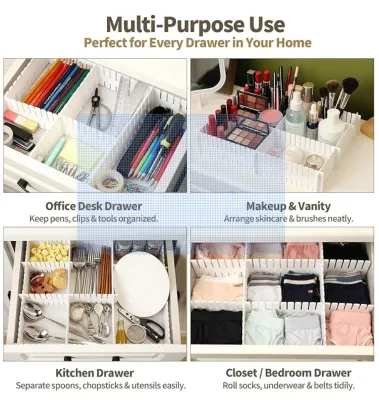
This is the most traditional setup — fixed plastic or wooden compartments that split the drawer into zones. The upside: it's sturdy and great for items that are all the same size. The downside: zero flexibility. Once you buy it, it's hard to adjust.
I picked up a set of fixed drawer dividers for a decent price, but after two months I ran into problems: my stuff kept changing sizes. My new power bank wouldn't fit in the original slot, while other compartments were way too big and wasted space.
Product recommendation: If your stuff stays pretty consistent, check out a fixed drawer divider set, price range $12-$25. Great for organizing socks, underwear, or stationery that doesn't change much.
2. Adjustable Divider System
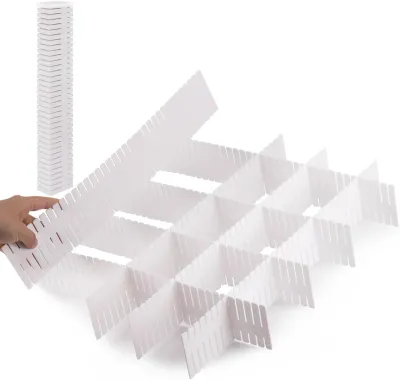
This is my top pick. Adjustable dividers usually have a main frame with movable separators, so you can tweak the length and width of each section to fit whatever you're storing.
My study drawer uses an adjustable system right now. The narrow left section holds pens and rulers, the wide middle section holds notebooks and calculators, the long right section holds my drawing tablet and cables. Last month I got a bigger drawing tablet, and it took me all of 30 seconds to readjust the dividers — that kind of flexibility is something fixed systems just can't match.
Product recommendations:
- Adjustable drawer divider set, price range $15-$35
- Spring-loaded drawer dividers, price range $10-$20
3. Modular Divider System
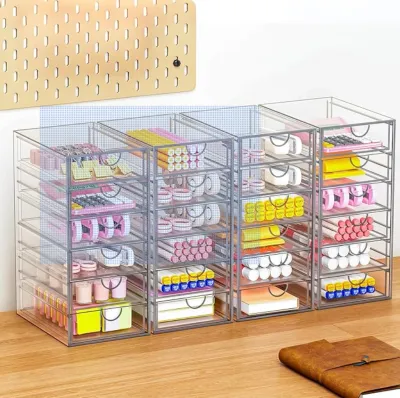
This is the premium option — multiple independent small boxes that you can take out individually or rearrange however you want. The best part about modular systems is you can mix and match 'em like building blocks, and you can pull individual modules out and use 'em right on your desk.
My tool drawer uses the modular setup. Screwdrivers in one module, tape and glue in another, electronic components in another. When I need to fix something, I just grab the module I need, take it to my desk, spread everything out to find what I'm looking for, then snap the lid on and put it back — no more "open the drawer and tiny parts roll everywhere" disasters.
Product recommendations:
- Modular drawer organizer set, price range $18-$40
- Drawer organizer modules with lids, price range $15-$30
Divider Solutions by Room
Desk Drawer: Stationery and Digital Accessories
A programmer's desk drawer is the most complex battlefield. Here's my setup:
Upper shallow drawer (under 2 inches): Use fixed small compartments for pens, USB drives, SD cards, paper clips. These things are tiny and all over the place — they need tight little slots.
Lower deep drawer (over 4 inches): Use adjustable dividers. Left side for chargers (standing them up saves space), middle for notebooks and sticky notes, right side for tools I use a lot (screwdrivers, tweezers, cable tester).
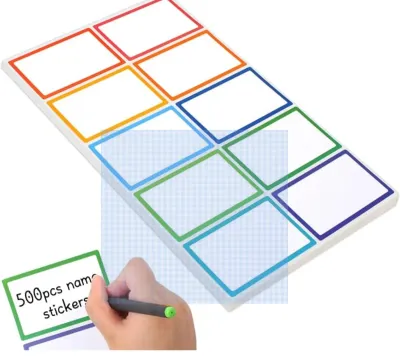
Quick tip: I use label stickers (price range $5-$12) on the edge of each section. Not only does it make finding stuff faster, but more importantly, putting things back doesn't require thinking — see the label, know where it goes.
Kitchen Drawer: Utensils and Tools
The kitchen drawer pain point is the huge size difference — everything from giant spatulas to tiny toothpicks has to fit in the same drawer.
My solution is "double-layer dividers": the bottom layer uses adjustable dividers for big zones (spatula zone, knife zone, miscellaneous zone), then I drop modular small boxes inside each zone. Like in the miscellaneous zone, little boxes separately hold bottle openers, peelers, measuring spoons — those small tools would still get all mixed up if they were just loose in the big zone.
Closet Drawer: Clothing Organization
For closet drawers, I'd go with fixed dividers — clothes (especially underwear and socks) are pretty uniform in size.
I picked up two sets of fabric drawer organizers (price range $10-$25), one set for socks (9 compartments, one pair per slot), one set for underwear (6 compartments, sorted by type). After six months, the big win: morning sock-finding time dropped from an average of 4 minutes to 10 seconds.
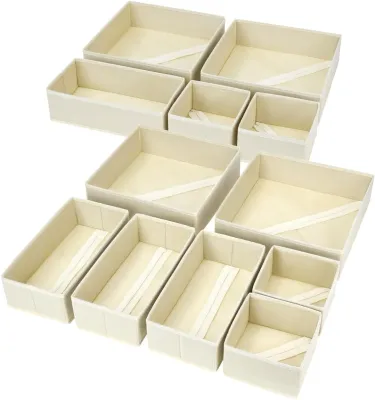
Tool Drawer: Parts and Accessories
A programmer's tool drawer often turns into a "hardware store" — all kinds of screws, resistors, cables, spare parts.
For this scenario, I can't recommend modular systems enough. The small parts organizer set (price range $15-$35) I use has 24 removable little boxes, each with its own lid. Resistors in one box, capacitors in another, screws in another — when you need 'em, grab the whole box, spread it on your desk to find what you need, snap the lid shut and put it back.
DIY Drawer Divider Tutorial
As a hands-on programmer, I also tried a few DIY approaches:
Cardboard Dividers (Lowest Cost)
Cut strips from shipping boxes, cross-lock 'em into a grid. The upside: basically free. The downside: not waterproof, not very durable — good for temporary use or while you're figuring things out in a rental.
My advice: if you're not sure your divider layout will work, try a cardboard version first for a couple weeks, adjust and optimize, then buy the real stuff once you've locked in the design.
Acrylic Dividers (Beautiful and Practical)
Order 3mm thick acrylic sheets online, cut to size, bond with acrylic adhesive. The upside: clear, looks great, easy to clean. The downside: you need tools (laser cutting or manual cutting), moderate cost.
I made an acrylic divider box for my digital accessories, cost about $20, and it looks super professional. If you've got a way to cut acrylic, this is a solid value option.
Wooden Dividers (Best Feel)
Use 3-5mm thick basswood or bamboo boards, cut and assemble. The upside: warm feel, eco-friendly. The downside: sensitive to moisture, takes some basic woodworking skills.
Divider System Maintenance and Adjustment
Setting up a divider system is just the first step — keeping it up is what matters. Here's my maintenance routine:
Monthly "code review": Open each drawer, check for "zombie items" — anything you haven't used in six months gets dealt with (donated or tossed).
Quarterly "refactoring": As the seasons change, what you use changes too. Sunscreen you use all summer moves to an easy-to-reach spot; hand warmers for winter can go to the back.
Label system maintenance: If a section's purpose changes, update the label right away. I once had a spot in my drawer labeled "spare phone," but I'd already sold the phone — and I forgot to change the label, so I kept putting my spare power bank there for three whole months.
Type Comparison and Rating
| Type | Price Range | Flexibility | Durability | Aesthetics | Rating |
|---|---|---|---|---|---|
| Fixed | $10-$25 | ★★☆☆☆ | ★★★★☆ | ★★★☆☆ | ⭐⭐⭐ |
| Adjustable | $15-$35 | ★★★★☆ | ★★★☆☆ | ★★★☆☆ | ⭐⭐⭐⭐⭐ |
| Modular | $18-$40 | ★★★★★ | ★★★★☆ | ★★★★☆ | ⭐⭐⭐⭐⭐ |
| DIY Cardboard | $0-$5 | ★★★☆☆ | ★☆☆☆☆ | ★★☆☆☆ | ⭐⭐ |
| DIY Acrylic | $15-$30 | ★★★☆☆ | ★★★★☆ | ★★★★★ | ⭐⭐⭐⭐ |
Final Thoughts
Drawer divider systems might seem like a small thing, but their impact on your daily routine is way bigger than you'd think. I now save 15 minutes a day on searching — that's 90 extra hours a year, enough to read 20 books or learn a new programming language.
More importantly, opening a drawer and seeing everything neat and organized — that sense of order subtly affects your mood. As a programmer, I know good architecture makes systems run smoothly; life's "architecture" starts with your drawers.
If you want to overhaul your drawers too, here's my advice: don't buy everything at once. Start with the messiest drawer, try a set of adjustable dividers. Once you get the hang of it, gradually expand to the others. Remember, organization isn't the goal — making life more efficient and comfortable is.
Related Articles
Modular Storage Systems Review: Organize Like Building
Complete modular storage systems review for 2026. Compare the best modular furniture systems for small apartments. Build your perfect storage solution...
Under Bed Storage Guide: Maximize Your Bed Space
Transform the space under your bed into organized storage. Learn which under-bed containers work best, how bed risers add inches, and our 2026 product...
Best Storage Bench 2026: Entryway & Bedroom Solution
Discover the best storage benches for small apartments in 2026. Compare entryway and bedroom storage benches by capacity, material, and price to find your...
Storage Ottoman with Tray Review: Multifunctional Seating
Is a storage ottoman with tray worth buying? Read my hands-on review coveringthe best models, tray design types, and real-world use cases for smallapartments.
Loft Bed Desk Review: Vertical Space Solution Small
Loft bed with desk reviews and buying guide for 2026. Compare the best high sleeper beds for small apartments and studios. Maximize vertical space with...
Best Storage Ottoman 2026: Top Picks for Small Apartments
Discover the best storage ottomans for small apartments in 2026. Compare top picks with drawers, lift-top designs, and budget-friendly options to maximize...